Russian marriage certificate translation
A marriage certificate is what changes a last name on paper — and the first thing USCIS looks at in a marriage-based Green Card case. We translate both spouses' names, before and after marriage, exactly as they appear in your passports. $25 for a standard certificate from Russia, the USSR, Ukraine, Belarus, Kazakhstan and other countries that issue documents in Russian, ready in 1–2 days.
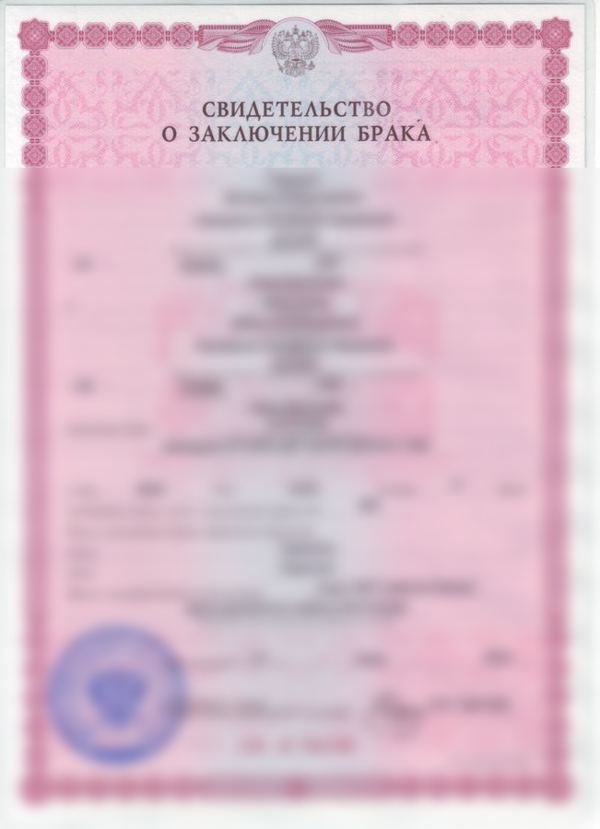
Every line of your certificate, including stamps
A Russian marriage certificate — свидетельство о заключении брака — is issued by the civil registry office (ZAGS). We translate the whole document word for word, so the English version matches the original line by line:
- Last name, first name and patronymic of both spouses
- Citizenship and, on older forms, ethnicity
- Date and place of birth of each spouse
- Date of marriage in figures and in words
- Marriage record (act) number and date
- Last names taken after the marriage
- Place of state registration (ZAGS office)
- Date of issue and official's signature
- Round seal, stamps and handwritten notes
- Series and number of the certificate
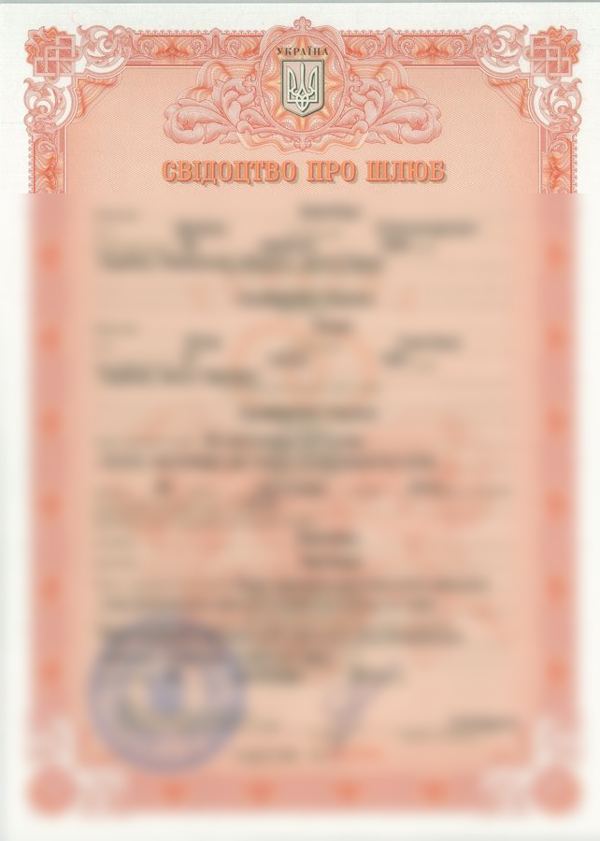
See what your translation will look like
Two of the 1,000+ marriage certificates we have translated since 2007: a new Russian form with a QR code and a Soviet RSFSR certificate. Names, dates and numbers are replaced with sample data.
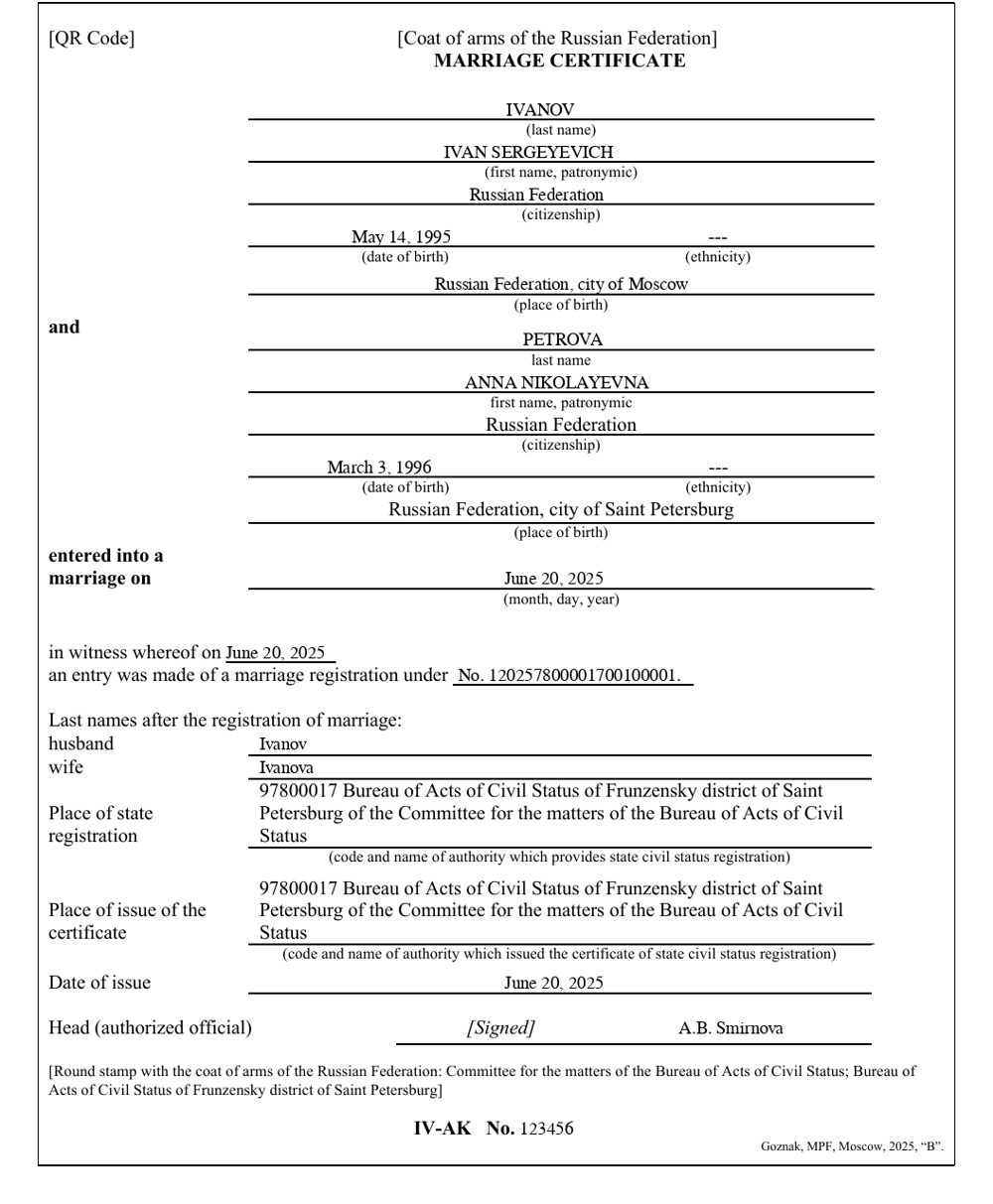
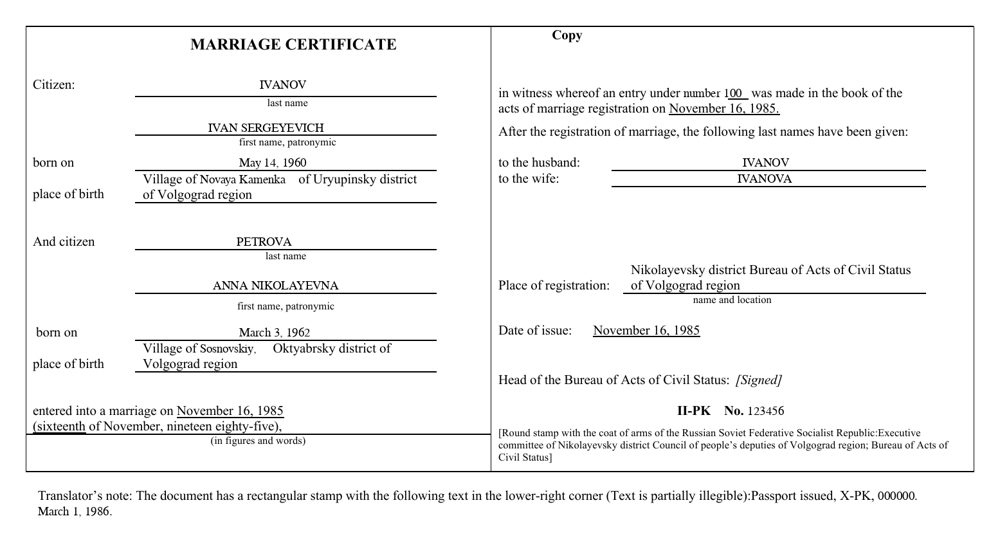
- Layout mirrors the original, so officers can compare line by line
- Stamps and seals are described in brackets; signatures marked [Signed]
- Dates in U.S. format — month, day, year
- Names spelled exactly as in your U.S. documents
Marriage certificates we translate
From Soviet-era booklets to the newest Russian forms — and archival marriage records issued when the original is lost.
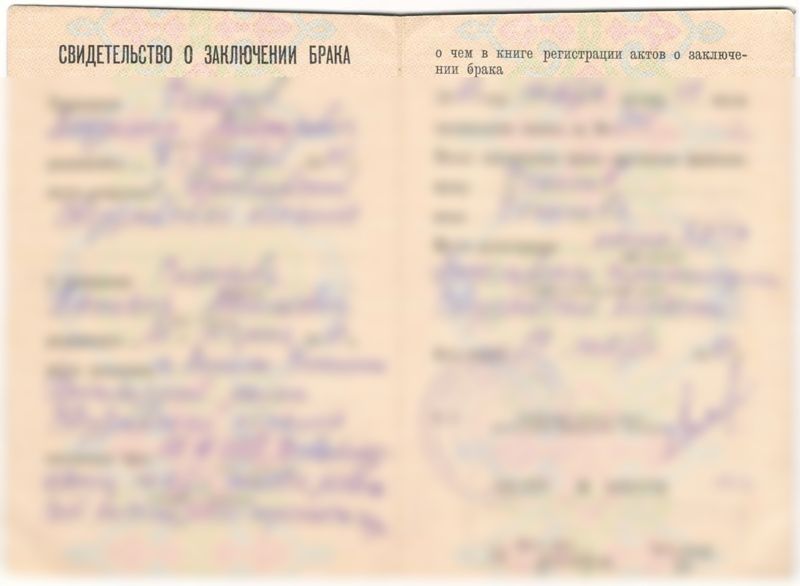
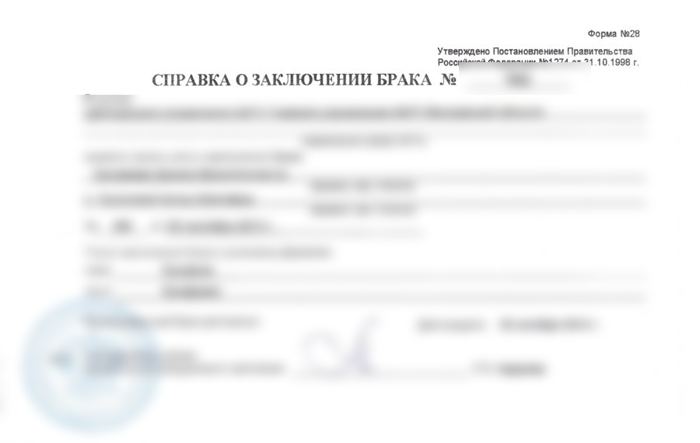
Personal data on all images is hidden for privacy.
Names are where most mistakes happen
A marriage certificate usually changes someone's last name — so the spelling has to match the passport, Green Card and Social Security records exactly.
Patronymic stays in
The patronymic (e.g. Sergeyevich) is not a middle name, but it is part of the name on the certificate. We keep it, so the translation matches the original exactly.
Male and female surnames
Russian last names change with gender — Ivanov for the husband, Ivanova for the wife. We translate each form as written and explain it in a note if needed.
Your spelling, not ours
Tell us how your names are spelled in your U.S. documents or foreign passport and we'll use exactly that — no conflicting versions between your forms.
Who asks for a translated marriage certificate
In a marriage-based case the certificate proves the relationship itself, and later it is the document that explains why your last name changed. Expect to show it more than once:
- Green Card through marriage — Forms I-130 and I-485, and immigrant visas processed by the NVC
- Naturalization — Form N-400, when your name changed through marriage
- Social Security and DMV — changing your last name on your SSN card, driver's license or REAL ID
- Courts — divorce, custody and inheritance cases in the U.S.
- Banks, insurers and employers — spousal benefits and name changes on accounts
Standard marriage certificate, Russian or Ukrainian → English. Archival records (Form No. 28), other languages and English → Russian are quoted individually.
- Certified and notarized
- Draft sent to you to check names and dates
- PDF by email in 1–2 days
- Hard copy by mail: Regular USPS +$13, Priority +$18, Priority Express +$39
Four simple steps
Send your documents
Scan or photograph your document — we accept all file types. Email it to us or send it on WhatsApp.
Make a payment
We email the price, turnaround and payment details. Pay by card, PayPal or Zelle, and send the English spelling of names.
Review the draft
We send a draft so you can check that names, dates and details match your other documents.
Done!
Receive your certified, notarized translation as a PDF by email, or by mail with wet signatures and stamps.
What our customers say
“Thank you for quick and accurate translation of my birth certificate. The manager asked all the right questions and helped me get the documents quickly, and the price was less than the other competitors. I highly recommend this service.”
“The translation of my power of attorney was done very well and fast. Their prices are very affordable. Do not be afraid to contact them. 100% positive company.”
When you need a signed paper copy
A PDF is enough for online filings — USCIS online applications and NVC uploads. Order a signed, notarized paper copy if you will need your translation in one of these situations.
Immigrant visa interview at a U.S. consulate
You upload scans to the NVC, but at the interview you must show the documents themselves. Bring the paper translation together with your original certificate.
“Every visa applicant … must bring … the original or certified copy version of all civil documents submitted to NVC.”
Source — U.S. Department of State, Interview Preparation: travel.state.gov
USCIS interview (Green Card, citizenship)
Photocopies are fine when you file, but the officer may ask to see the originals. Bring the signed paper translation to your interview.
“USCIS may, at any time, request submission of an original document for review.”
Source — 8 CFR 103.2(b)(5): www.ecfr.gov
Courts
Requirements vary by court. Many courts ask for a signed original translation, sometimes with a notarized translator's affidavit. Check with the clerk before you file — we can prepare either.
DMV and REAL ID
Your documents are checked in the original, so bring a paper translation too. Rules differ from state to state.
Paper copy by mail: Regular USPS +$13 · Priority (2–3 days, tracking) +$18 · Priority Express (1–2 days, tracking) +$39. Choose it when you order online.
Send us the English spelling of every name
With your documents, please send the last name, first name and patronymic of every person in them — exactly as spelled in your U.S. documents or foreign passport (Green Card, Social Security card, visa). This way everything stays consistent with your other American documents, immigration applications and forms you have already filed. If a name has no English spelling yet, we'll transliterate it by standard rules. Already made your own translation? Send it along — we'll use it as a reference for names and places, while the certified translation is done from the original.
The patronymic stays in
Many clients don't use a patronymic in the U.S. and ask us to leave it out. We can't: a certified translation must be complete and match the original, so if the document shows a patronymic (Sergeyevich, Ivanovna), the translation shows it too. This does not cause problems — officers expect it on documents from Russia, Ukraine and other former Soviet countries. Have a passport from another country — Germany or Israel, for example — with no patronymic at all? Same rule: your first and last name are spelled exactly as in that passport, so they match your American documents and applications, and the patronymic from the original is transliterated by standard rules.
Qualified linguists, not a translation app
Since 2007 we have translated more than 12,000 Russian and Ukrainian documents — over 30,000 pages — and not one of our translations has ever been rejected by USCIS.
Never rejected by USCIS
Every translation comes with a signed certificate of accuracy that meets USCIS translation requirements.
Court-certified interpreters
Our team includes California court-certified interpreters and Washington State certified translators.
Degreed linguists
Every translator holds a university degree in linguistics or foreign-language teaching.
Notarized at no extra cost
Accepted by USCIS, NVC, WES, ECE, U.S. courts, SSA, DMV, schools and employers.
Do I need an ATA-certified translator? No. USCIS, the NVC, WES, ECE and U.S. courts do not require ATA certification for document translations. They require a complete, accurate English translation with a signed statement that the translator is competent to translate — which is exactly what we provide.
Marriage certificate translation questions
Is a Soviet (USSR) marriage certificate still valid?
Yes. Certificates issued in the USSR remain valid civil status documents, and we translate them regularly — including Soviet republics such as Ukraine, Belarus, Kazakhstan and Uzbekistan. Stamps with the coat of arms of the Soviet republic are described in the translation.
I lost my marriage certificate. What can I do?
You can request a duplicate certificate (повторное свидетельство) or an archival statement of marriage registration from the ZAGS office where the marriage was registered. We translate both, including the Form No. 28 statement.
Our marriage was dissolved. Which document do I need?
Usually both the marriage certificate and the divorce certificate or court decision. Some archival statements also note that the marriage was dissolved — we translate that note too. Send us everything you have and we'll tell you what you need. If the marriage ended because a spouse passed away, the proof is the death certificate.
My last name changed after marriage, but some of my documents still show the old one. Is that a problem?
No — that is exactly what the marriage certificate is for. It shows both spouses' last names before and after registration, and our translation keeps both, spelled as in your passports. Offices like the SSA and USCIS use it to connect your old and new names.
We married outside Russia or at a consulate. Can you translate the certificate?
Yes. We translate marriage certificates issued in Ukraine, Belarus, Kazakhstan, Uzbekistan and other countries, as well as certificates issued by Russian consulates abroad.
Can the marriage stamp in my passport replace the certificate?
U.S. agencies ask for the marriage certificate itself. The stamp in an internal passport only shows that a marriage was registered. If you need that page as well, we translate it too — see passport translation.
General questions — whether USCIS accepts our translations, apostilles, PDF or paper — are answered on the certified translation page.